
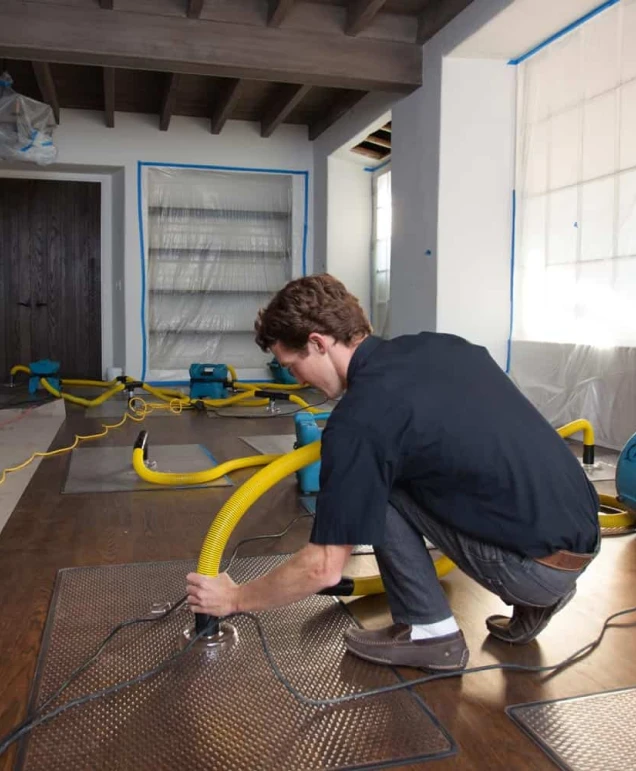
Structural Drying for Missouri City Homeowners
When water gets into the bones of your home, drying out the surface is not enough. Moisture trapped inside walls, subfloors, and framing continues to cause damage long after the visible water is gone. Rhino Water Damage Restoration provides professional structural drying for Missouri City properties, using commercial-grade equipment and IICRC-certified methods to remove moisture at the source.
Missouri City sits in Fort Bend County, where high humidity, heavy seasonal rainfall, and a large number of slab-on-grade homes create conditions where water intrusion can turn serious fast. Our team serves neighborhoods throughout the city, from Quail Valley and Sienna Plantation to Lake Olympia and the communities along Voss Road. We arrive equipped to handle everything from a single room to a full-structure event.
What’s Included in Our Structural Drying Services
When you hire Rhino Water Damage Restoration for structural drying in Missouri City, you get more than fans and dehumidifiers. Every job follows an IICRC S500-compliant process, backed by daily monitoring and complete documentation for your insurance claim.
Thermal Imaging and Moisture Mapping
We use thermal imaging cameras and digital moisture meters to find water hidden behind drywall, under tile, and inside cabinetry. Many Missouri City homes have brick veneer exteriors and dense insulation that traps moisture where you cannot see it. Accurate mapping at the start means we place equipment correctly and do not leave wet pockets behind.
Commercial Drying Equipment Placement
Our crews deploy high-velocity air movers and low-grain refrigerant dehumidifiers sized for the specific job. For severe cases involving concrete slabs or engineered wood floors, we also use desiccant dehumidification units. Equipment placement follows a calculated drying plan, not guesswork, and we adjust it daily based on moisture readings.
Documentation and Insurance Support
Every visit is logged with moisture readings, equipment settings, and photos. This documentation is essential for insurance claims and gives you a clear record of exactly what was done. Rhino Water Damage Restoration works directly with most major carriers and can help you file and manage your claim from the first call through final sign-off. Contact us today to get started.
Signs You Need Structural Drying After Water Damage
A lot of Missouri City homeowners call us days or even weeks after water damage, not realizing that moisture had already moved into structural materials. Knowing the warning signs can help you act before mold takes hold or framing begins to deteriorate.
Musty Odors That Won’t Go Away
A persistent musty smell after flooding or a plumbing leak is one of the clearest signs that moisture is still trapped in structural materials. In Missouri City’s climate, mold can begin developing inside walls within 48 hours of saturation. By the time you smell it, the drying window is already closing. This is when mold remediation may also be needed alongside drying work.
Buckled Flooring or Soft Spots in Wood
Hardwood, laminate, and engineered flooring will buckle, cup, or develop soft spots when the subfloor beneath them holds moisture. Many Missouri City homes built in the 1980s and 1990s used OSB subfloor panels that absorb water quickly. If your floors feel spongy or look uneven after a water event, structural drying should start immediately.
Water Stains on Walls or Ceilings After a Flood
Staining on drywall after flooding or a roof leak indicates that water has already soaked into the wall assembly. Fort Bend County experiences significant rainfall during hurricane season, and even a minor roof intrusion can push gallons of water into attic framing and ceiling cavities. Waiting until the stain dries on its own does not mean the moisture is gone. If your property was affected by flood cleanup recently, a structural drying assessment is a smart next step.
Acting within the first 24 to 72 hours of water exposure gives you the best chance of saving structural materials and avoiding a mold problem. The longer moisture sits, the more damage it causes.
Our Structural Drying Process for Missouri City Properties
Schedule Your Emergency Assessment
Call Rhino Water Damage Restoration any time and our Missouri City team will dispatch a certified technician to your property. We ask a few quick questions about the water source and how long ago the event occurred so our crew arrives ready. Emergency calls are prioritized and we aim for same-day response throughout Missouri City and surrounding Fort Bend County communities.
Inspect Your Property and Locate Hidden Moisture
Our technicians walk the entire affected area with thermal imaging cameras and calibrated moisture meters, checking walls, floors, ceilings, and any adjacent rooms that may have received migrating water. Missouri City slab foundations are a common pathway for water to travel under flooring into areas far from the original leak. We document everything we find before any equipment is placed.
Deploy Equipment and Execute the Drying Plan
Once the moisture map is complete, we set up air movers and dehumidifiers according to a calculated drying plan specific to your home’s layout and the materials involved. Our team returns daily to take readings, adjust equipment, and keep you updated on progress. We also coordinate with your insurance adjuster directly, providing moisture logs and photos at every stage. If the situation also involves sewage exposure, our sewage backup cleanup team can respond alongside the drying crew.
Complete the Final Inspection and Close Out the Job
We do not close out a structural drying job until all moisture readings have reached the IICRC-standard dry goal for every affected material type. You receive a final report with before-and-after moisture data, equipment logs, and a summary of completed work. If any repairs are needed after drying is complete, our team can connect you with trusted local contractors in Missouri City and the broader Fort Bend County area. For properties with ongoing humidity concerns, we also offer crawl space encapsulation as a long-term protective measure.